Why HMRC Plans to Reclassify Uncorrected Tax Errors as Deliberate From April 2028
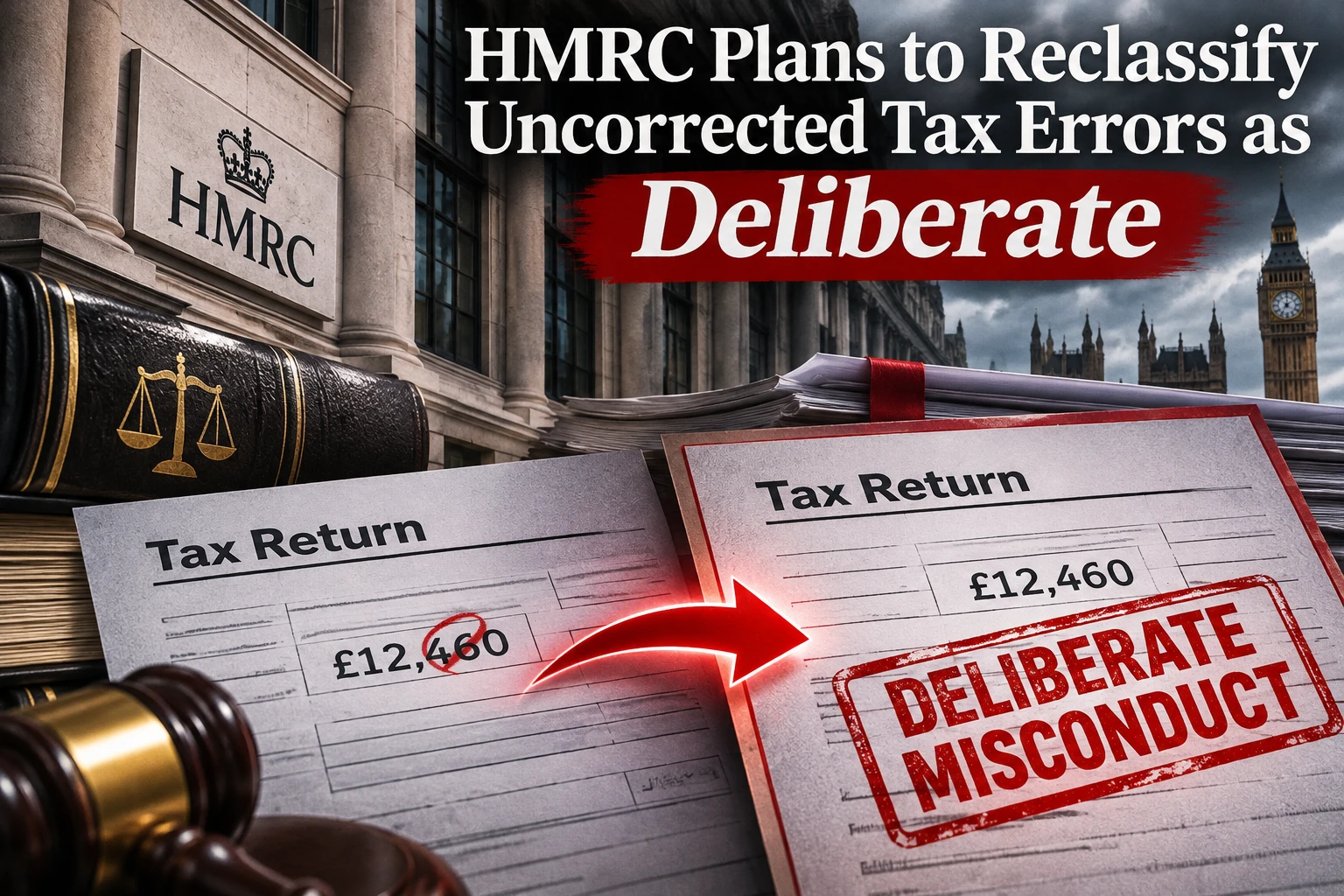
From 1 April 2028, a tax error you know about but leave unfixed will count as deliberate. That holds even when the first mistake was an honest one. HMRC plans to reclassify uncorrected tax errors as deliberate through new law in the Finance Bill 2026-27.
A deliberate label brings bigger penalties. It also lets HMRC look back up to 20 years instead of six. If you file a Self Assessment return in Leeds, Bradford or anywhere in Yorkshire, this change affects you.
The Change in One Paragraph
HMRC is creating a legal duty to correct. Once you spot a mistake that cut your tax bill, you must take reasonable steps to fix it. If you do nothing, HMRC will treat the error as deliberate for penalty purposes. HMRC also gains a new letter called a Customer Correction Notice. It points to a suspected error and gives you a deadline to fix it or explain it.
Where the Law Stands Right Now
Draft Legislation Becomes a Finance Bill Measure
HMRC published its policy paper, Modernising the correction of errors, on 13 July 2026. A technical consultation ran until 7 September 2026. The government then confirmed the measure at the Autumn Budget.
It now sits in the Finance Bill 2026-27, which passed its first reading on 3 November 2026. The rules apply to periods ending on or after 1 April 2028. Parliament can still change the wording before the bill becomes law.
Why HMRC Wants Errors Fixed Sooner
HMRC figures show careless mistakes by individuals and small firms make up a large share of the tax gap. Some people spot an old error and stay quiet. HMRC wants to end that habit.
Its policy paper says the aim is to free up officers for complex cases.
Today's Rules Compared With the 2028 Rules
Situation | Treatment today | Treatment from April 2028 |
|---|---|---|
Honest error, fixed once found | No penalty, 4 year lookback | No penalty, 4 year lookback |
Honest error, found but left alone | Careless, up to 30%, 6 year lookback | Deliberate, up to 70%, 20 year lookback |
Careless error, found but left alone | Careless, up to 30%, 6 year lookback | Deliberate, up to 70%, 20 year lookback |
HMRC notice ignored | No such notice exists | Error presumed careless at least |
First notice in six years, fixed on time | No such notice exists | No penalty for a careless error |
Schedule 24 of the Finance Act 2007 already treats an innocent error as careless if you find it and stay silent. The new rule pushes that same silence one band higher.
Inside the New Duty to Correct
The Moment You Become Aware of a Mistake
The duty starts when you become aware of an inaccuracy. The draft law does not define that moment. It could be when you notice a missing payslip. It could be when your bookkeeper flags a wrong expense.
The Chartered Institute of Taxation (CIOT) and the Low Incomes Tax Reform Group have both asked HMRC for clear guidance. Until it arrives, treat any doubt about a past return as a reason to check it.
What HMRC Accepts as Reasonable Steps
The draft law lists two steps. If you can still amend the return, you amend it. If you cannot, you tell HMRC so it can correct the figure.
There is no fixed number of days in the draft. Act quickly and keep a note of each step you take.
Returns and Taxes the Duty Covers
The duty reaches far beyond Self Assessment. It covers income tax, corporation tax, VAT, inheritance tax, stamp duties and excise duties. It also covers documents HMRC relies on, such as company accounts.
The duty only bites on errors that understate tax or inflate a loss or repayment. A mistake where you overpaid does not trigger it.
Why an Honest Slip Can Now Carry a Deliberate Penalty
Penalty Bands by Behaviour Type
HMRC sets penalties as a percentage of the extra tax due. It calls this potential lost revenue. Careless errors carry up to 30%. Deliberate errors carry up to 70%. Deliberate and concealed errors carry up to 100%, and offshore matters can go higher.
Prompted vs Unprompted Disclosure Discounts
Telling HMRC first cuts your penalty. HMRC calls this an unprompted disclosure. If HMRC finds the error first, the disclosure is prompted and the minimum rises.
Behaviour | Unprompted minimum | Prompted minimum | Maximum |
|---|---|---|---|
Careless | 0% | 15% | 30% |
Deliberate | 20% | 35% | 70% |
Deliberate and concealed | 30% | 50% | 100% |
Under the new rules, a careless slip you leave alone moves into the deliberate row. Your lowest possible penalty jumps from 0% to 20%.
Why the Lookback Grows to 20 Years
HMRC can normally assess tax up to four years back. That rises to six years for careless errors. Deliberate errors open a 20 year window.
So one ignored mistake on a 2028 return could be reopened in 2048.
HMRC Customer Correction Notices Step by Step
What a Notice Asks You to Do
HMRC can issue a notice when it suspects an error it can still correct. The notice names the suspected error and sets a deadline. You then have two choices. You fix the error, or you explain why no error exists.
HMRC does not have to accept your explanation. Strong evidence matters.
A Sample Notice Timeline
The draft law lets HMRC set each deadline. Here is how a typical case might run.
Day 1. A notice arrives about rental income on your 2028 to 2029 return.
Week 1. You gather bank statements, tenancy agreements and letting agent reports.
Week 2. Your adviser checks whether the figure was wrong.
Before the deadline. You amend the return or send a written explanation with evidence.
After the deadline. HMRC reviews your reply and may open a compliance check.
If you miss the deadline, HMRC will presume the error was at least careless. You then carry the burden of proving you took reasonable care.
How the First Notice Safe Harbour Protects You
Say this is your first notice in six years. If you fix a careless error by the deadline, no penalty applies.
You still pay the tax and interest. An explanation alone does not earn this relief.
Disagreeing With a Notice and Your Appeal Rights
You may believe your figure was right. In that case, send a clear written explanation with evidence before the deadline.
If HMRC later charges a penalty, you keep your normal rights. You can ask for an internal review or appeal to the tax tribunal within 30 days. Our tax investigation services cover replies to HMRC checks and penalty disputes.

Two Yorkshire Examples
A Leeds Landlord With Undeclared Rent
Sarah lets a two bed flat in Headingley. In 2029 she finds £5,000 of rent missing from an old return. At basic rate, that is £1,000 of tax.
If she tells HMRC straight away, her careless penalty could be nil. If she ignores it and HMRC finds out, the error counts as deliberate. Her penalty could then reach £700, with a floor of £350. Interest runs on top from the original due date.
A Bradford Sole Trader With an Expense Error
Imran runs a joinery business in Shipley. In 2029 he receives his first notice from HMRC. It flags £3,000 of car costs that included private trips.
That claim cut his income tax by £600. He amends the return before the deadline. As this is his first notice in six years, his careless penalty is nil. He pays the £600 plus interest.
Good self employed accounting support catches a private and business split like this before you file.
Fixing a Self Assessment Error Before 2028
Right now, the stakes are lower. An error you fix today costs less than one you leave until after April 2028. A self assessment tax return accountant can check your recent returns before the new rules start.
Inside the 12 Month Amendment Window
You can amend a Self Assessment return up to 12 months after the 31 January filing deadline. For the 2024 to 2025 tax year, you have until 31 January 2027.
Log in to your HMRC online account, update the figures and HMRC recalculates your bill.
After the Window Closes Through Voluntary Disclosure
Once the window shuts, write to HMRC or use its Digital Disclosure Service. Explain the error, the years it affects and the tax owed. An unprompted disclosure keeps your penalty as low as the law allows.
The Let Property Campaign Route for Landlords
Landlords with undeclared rental income have their own route. HMRC's Let Property Campaign lets you notify HMRC, then work out and pay what you owe.
It suits many Yorkshire landlords with student lets in Hyde Park or a single inherited house in Wakefield. Our property accountants in Yorkshire can work out the figures and file the disclosure for you. Using this route before 2028 keeps you clear of the tougher rules.
Lessons From the 2017 Requirement to Correct
HMRC has used this approach before. The Requirement to Correct, in the Finance (No. 2) Act 2017, targeted undeclared offshore income. Taxpayers had until 30 September 2018 to come forward. Those who missed it faced penalties of up to 200%.
The new duty applies the same idea to every tax and every taxpayer. People who acted before the 2018 deadline paid far less.
Gaps HMRC Has Not Closed Yet
Old Returns and Historic Errors
It is not yet clear if the duty covers errors made before April 2028. Old returns still inside HMRC's time limits could be caught. Until HMRC settles this, assume older errors matter too.
No Minimum Error Threshold
The draft has no de minimis limit. In theory, a £20 slip falls under the same duty as a £20,000 one. The CIOT has asked for a small error threshold.
Undefined Timescales for Correction
The draft does not say how fast you must act. Until HMRC publishes guidance, a prompt and documented response is your best protection.
Keeping Records That Cover a 20 Year Window
Sole traders and landlords normally keep records for five years after the 31 January deadline. A deliberate label lets HMRC look back 20 years. That gap leaves many people without the papers to defend themselves.
Store bank statements, invoices and letting records digitally. Regular bookkeeping keeps those records tidy and easy to find. Keep a short log of any error you find, the date you found it and what you did. That log could prove you took reasonable steps.
A Quick Error Check for Your Past Returns
Run these five checks on your last four returns.
Did you declare all rent, including short lets and holiday lets?
Did you include every source of income, such as side work or tips?
Did you split private and business use for cars and phones?
Did you report savings interest and dividends above your allowances?
Did you report any capital gains tax due on property or shares you sold?
If any answer is "not sure", look again now.
Speak to a Tax Advisor in Leeds
SAS Yorkshire helps landlords, sole traders and small companies across Leeds, Bradford, Wakefield and Harrogate. We review past returns, spot errors and handle disclosures with HMRC. We also reply to correction notices for you.
Talk to a tax advisor leeds before April 2028 raises the price of silence. Contact us to book a review of your past returns.
Frequently Asked Questions
Is the duty to correct already law?
Not yet. It sits in the Finance Bill 2026-27, which passed its first reading in November 2026. The rules are due to apply from 1 April 2028.
Does a mistake on my 2022 return fall under the new rules?
HMRC has not confirmed this. Errors on old returns still within time limits may be caught. Fixing them now removes the risk.
How long do I have to respond to a Customer Correction Notice?
Each notice sets its own deadline. The draft law does not fix a number of days. Act well before the date shown.
Can my accountant correct an error on my behalf?
Yes. Your agent can amend your return or make a disclosure for you. You still carry legal responsibility for the figures.
Will HMRC charge interest as well as a penalty?
Yes. Late payment interest runs from the date the tax was first due. It applies even when HMRC charges no penalty.
What if I find a small error worth under £100?
The draft has no minimum threshold. Correct it anyway. Small fixes are quick and remove any future risk.