HMRC Scam Letter | Spot It, Stop It, Report It | HMRC Investigation
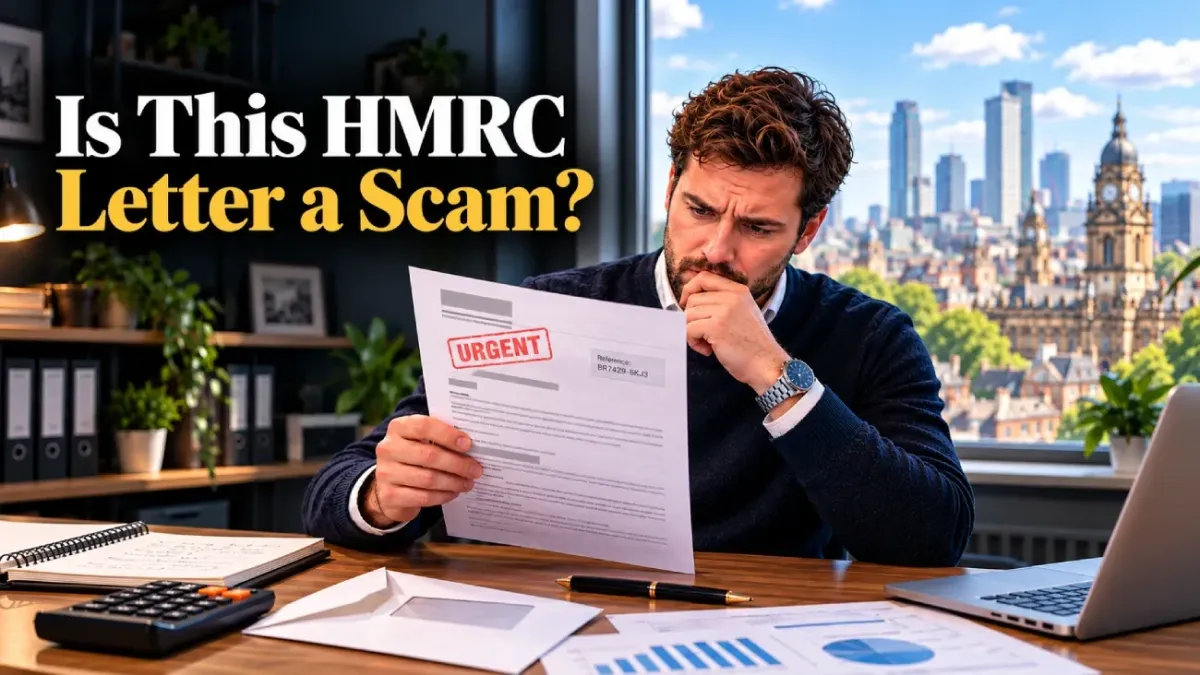
A letter with HMRC printed at the top can ruin your morning. Your stomach drops before you finish the first line. Then something about it does not sit right.
Trust that feeling, but do not act on it yet. Today's fakes are polished enough to fool careful people. Yet real HMRC post can look just as alarming.
This guide takes you through the letter one step at a time. It comes from tax advisors who check HMRC post for clients from Leeds to Hull, and from Harrogate to Sheffield.
Just Opened a Worrying HMRC Letter? Your First 10 Minutes
In the first 10 minutes, your only job is to do nothing you cannot undo. A real letter will still be real tomorrow. A fake one only works if you move quickly.
So for now, hold off on these:
Phoning any number on the letter. Scammers often answer these lines themselves.
Paying anything. Not by card, transfer, voucher or any other route.
Scanning a QR code. It could open a copycat site.
Emailing documents. That includes bank statements, accounts or photo ID.
Instead, put the kettle on and read the letter again slowly. Then move to the next section. It shows you what to look for.
Read the Letter the Way an Accountant Would
When a client hands us a letter, we ask four questions. Who sent it, what does it want, how should you reply, and how fast? The answers tell us almost everything.
Who does it say it is from?
Look for the name of an HMRC team, such as Self Assessment or VAT. Then check the reference near the top. A real letter usually quotes your Unique Taxpayer Reference (UTR) or your National Insurance number. If that number is missing or does not match your records, be wary.
What does it want from you?
Real letters ask about a named tax, a return or a payment. They tell you which tax year they mean. Fakes tend to ask for a pile of private documents with no clear reason, such as passport copies and a year of bank statements.
How does it want you to reply?
This is the question that catches most fakes. Genuine HMRC letters point you to the post, GOV.UK or a helpline. HMRC says any request to email an address that does not end in hmrc.gov.uk is not genuine.
How quickly does it want an answer?
HMRC deadlines are firm, but fair. Its overdue payment letter, for example, gives you 28 days to pay or get in touch. A letter that demands action within hours, or threatens to shut your business, is playing on your nerves.
The Scam Letters Doing the Rounds in Yorkshire Right Now
Four types of fake letter keep turning up on Yorkshire doormats. Each one copies something HMRC or Companies House really does, which is why they work.
The "verify your declared income" letter
This HMRC scam letter claims to come from an "Individuals and Small Business Compliance" team. It says the government is checking declared income. Then it asks you to email over:
bank statements covering 13 months
your most recent filed accounts
four quarters of VAT returns
photo ID for each director
The reply address uses hmrc-taxchecks.org, not a government address. A threat to freeze your business sits at the bottom to rush you.
Fake Companies House ID verification letters
Since November 2025, company directors have had to prove who they are to Companies House. Fraudsters jumped on this. The ICAEW reported letters from bogus accounting firms charging fees to complete the check. In fact, almost every director can verify for free using GOV.UK One Login.
Refund bait letters
These dangle a tax rebate in front of you. To get it, you must call a number or share your card details. A genuine refund form posts back to HMRC. It never goes to a private phone line.
Lookalike QR codes
Some real HMRC letters carry a QR code that opens a GOV.UK page. HMRC publishes a full list of these letters. A fake code sends you to a copycat login or payment page instead.
Red Flags and Green Flags at a Glance
A single red flag is reason enough to stop. Green flags make a letter more likely to be real, but none of them proves it alone. Use this table side by side with your letter.
Red flag | Green flag |
|---|---|
Reply to a .org, .com or Gmail address | Reply by post or through GOV.UK |
Send passport or licence copies by email | Answer questions about one named tax |
Pay today or face court, bailiffs or arrest | Clear deadline, often 28 or 30 days |
Pay by gift card, voucher or crypto | Pay to an HMRC account shown on GOV.UK |
Call a mobile or 09 number | Call an 0300 number you find on GOV.UK |
No UTR, or one you do not recognise | Your correct UTR or National Insurance number |
QR code opens a login or payment page | QR code opens a GOV.UK guidance page |
Nothing shows in your HMRC account | A matching message or balance online |
4 Myths That Catch Yorkshire Taxpayers Out
Much of the advice online is out of date. Scammers know this and design their letters around it. These four myths come up again and again in our client chats.
"It has a BX9 postcode, so it must be real"
BX9 postcodes are genuine HMRC postcodes. That is exactly why fraudsters copy them. The "verify your declared income" letter used BX9 1QE. A postcode tells you nothing about who really sent the letter.
"There are no typos, so it is genuine"
Years ago, poor spelling gave most fakes away. Today's versions are tidy, well laid out and use the right tax terms. Judge the letter by what it asks you to do, not by its grammar.
"HMRC never asks for bank details by post"
This one surprises people. Some real HMRC letters do include a paper form for your bank details, such as certain National Insurance refund letters. The safe test is where the form goes. A real one goes back to HMRC by post, never to an email address or a phone line.
"If it were real, HMRC would email me as well"
HMRC does not email or text about refunds or penalties. So a real penalty letter will often arrive with no email at all. The lack of an email is not a warning sign. An email about a refund, on the other hand, is.
Who Scammers Target Most Across Yorkshire
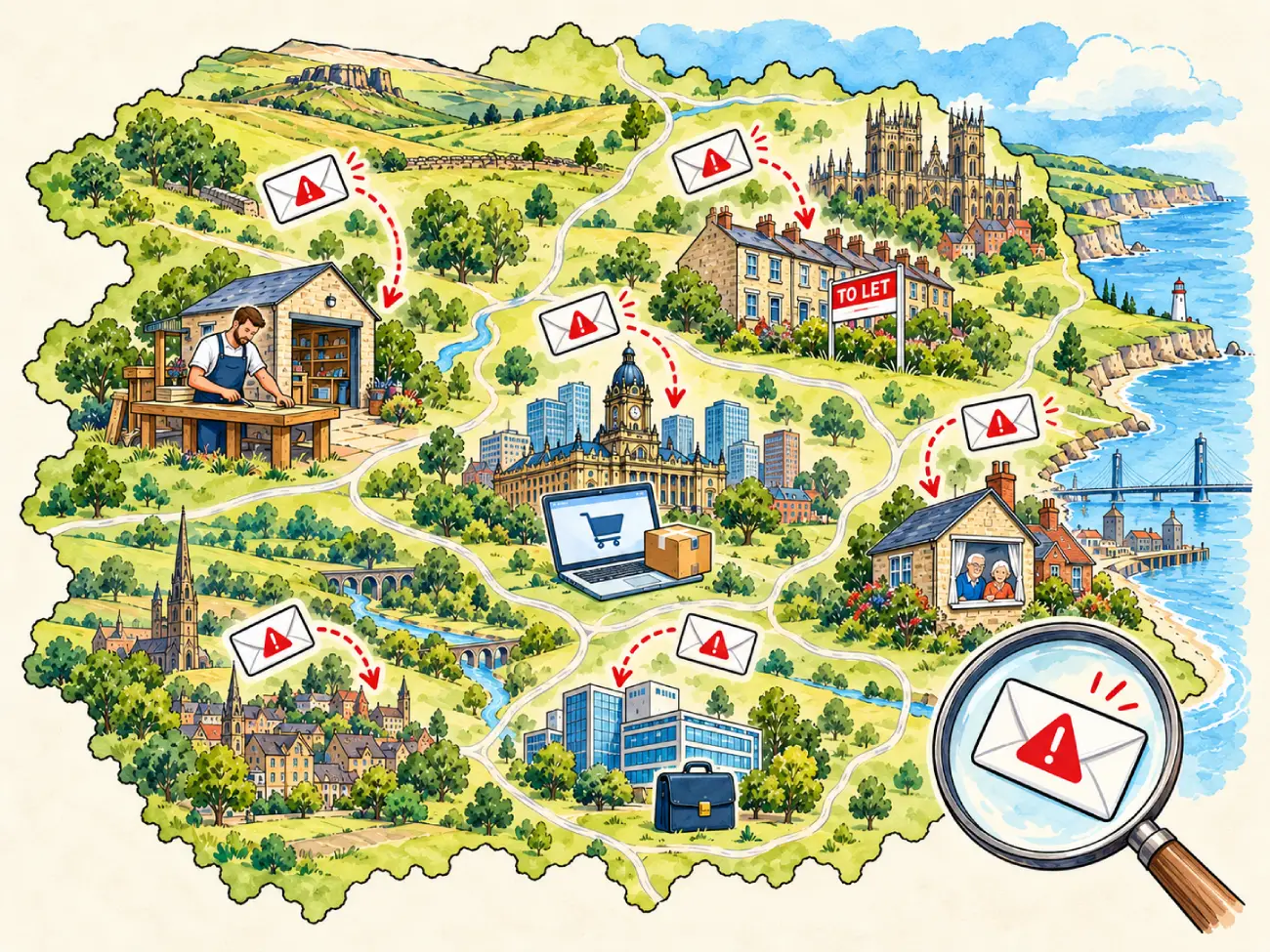
Fraudsters go after people who already expect HMRC post. That way, a fake letter feels routine. Across the county, these are the groups we see most at risk.
Sole traders in Bradford, Halifax and Huddersfield. Many run busy trades with little time for admin. A letter about "declared income" lands right on a worry they already have.
Landlords in York and Harrogate. Holiday lets and student houses bring in rental income each year. Scammers know landlords expect tax letters, so a fake demand does not stand out.
Company directors in Sheffield, Wakefield and Leeds. The Companies House ID rules are still fresh. Directors from Kelham Island start ups to Wakefield family firms are easy to unsettle.
Online sellers and creators. In summer 2026, HMRC wrote to people it thought owed tax on online sales and social media income. Real letters like these make copycat versions easier to believe.
People close to State Pension age. HMRC sends genuine letters about National Insurance refunds to some older taxpayers. A copycat version asking for the same details would be easy to fall for.
If you fit one of these groups, keep this page handy. You are more likely to see a fake, and more likely to see a real letter too.
3 Safe Ways to Confirm a Letter Without Using Its Contact Details
The golden rule is simple. Only use contact routes you find yourself. Never trust the phone number, web address or QR code printed on a letter you doubt.
1. Open your HMRC online account or the HMRC app. Type GOV.UK into your browser and sign in to HMRC online services. Look for a balance, deadline or message that matches the letter. Not every letter appears online, so a blank account is a prompt to check further, not proof of a scam.
2. Search HMRC's published lists. HMRC keeps a list of genuine letters it has recently sent. It also lists letters with QR codes, and contact that uses more than one method, such as a letter followed by a call.
3. Phone the HMRC team the letter names. Find the number yourself on HMRC's contact page. This is what HMRC itself advises for a letter you are unsure about. Have the reference number ready and ask whether they sent it.
Stuck on hold, or still unsure after all three? Send the letter to your accountant. A second pair of trained eyes often settles it in minutes.
The Letter Is Real. What Happens Next?
A real letter is not a disaster. It is a deadline. Most HMRC problems only grow when people put the letter in a drawer and hope it goes away.
Here is how to handle it well:
Find the deadline and write it down. Many HMRC letters give 28 or 30 days. Put the date in your phone today.
Work out what HMRC actually wants. Is it a return, a payment, some information or a correction? Underline it.
Pull your records together. Bank statements, invoices and past returns all help, even if HMRC has not asked for them yet.
Reply using the route the letter gives. That might be your online account, the post or a named helpline.
Push back if HMRC has it wrong. You can disagree with a tax decision or penalty, but there are time limits.
Many letters we see in 2026 relate to Self Assessment. HMRC has been registering people it thinks owe tax on side income. If that is you, a self assessment tax return accountant can file your first return and make sure you claim every allowable expense.
Shared Your Details Already? A Damage Control Plan
If you replied to an HMRC scam letter, you are far from alone. What matters now is speed. Find the line that matches what you sent, and start there.
You paid money. Ring your bank at once on the number printed on your card. You can also dial 159, which connects you to most UK banks' fraud teams. The sooner the bank knows, the better your chance of stopping the payment.
You shared a login or password. Change your Government Gateway or GOV.UK One Login password straight away. Then email HMRC's security team at [email protected]. Say what you shared, such as your user ID, but do not type the details themselves.
You sent photo ID. A passport or licence copy lets criminals pose as you. Check your credit file with Experian, Equifax or TransUnion for new accounts. If you are a director, watch your Companies House record for changes you did not make.
You sent bank statements or accounts. Tell your bank, as the statements show your account details. Ask whether it can add extra checks to your account.
In every case, keep the letter and envelope. Then report the crime to Report Fraud, the service that took over from Action Fraud in December 2025.
Report It and Help Protect Your Neighbours
Reporting takes five minutes and helps shut scams down. HMRC sets out a different route for each type of contact on its GOV.UK reporting page.
Letters: contact the HMRC team the letter claims to be from, using a number from GOV.UK.
Emails: forward them to [email protected].
Texts: forward them to 60599.
WhatsApp or other app messages: screenshot them and email [email protected].
Phone calls: use HMRC's online form for suspicious calls.
Lost money: call your bank first, then Report Fraud on 0300 123 2040.
Then tell the people around you. A fake letter rarely lands on just one doormat. A quick word with a parent, a neighbour or your business group chat could save someone else a lot of grief.
Tax Advisors Who Check HMRC Letters Across Yorkshire
Not sure about a letter? Send it to us and we will give you a straight answer. If it is real, we will help you reply properly and on time.
HMRC's regional centre for Yorkshire sits at Wellington Place, near Leeds station. But there is no public desk where you can walk in with a letter. That leaves a long phone queue, or an advisor who knows what to look for.
We help people right across Yorkshire:
West Yorkshire: Leeds, Bradford, Wakefield, Huddersfield and Halifax
North Yorkshire: York, Harrogate and Scarborough
South Yorkshire: Sheffield, Doncaster, Rotherham and Barnsley
East Yorkshire: Hull, Beverley and the wider East Riding
Once you authorise us as your agent, HMRC can speak to us directly. You no longer have to sit on hold or decode the letters yourself. Looking for a trusted tax advisor leeds firm with clients across the region? You are in the right place.
To get a letter checked, email a clear photo of every page to [SAS Yorkshire email]. Cover any bank or card numbers before you send it.
Frequently Asked Question
Can scammers know my real name and address?
Yes. Personal details leak through data breaches and public records. Company directors' details also appear on the Companies House register. So a letter with your correct name is not proof it came from HMRC.
Is it safe to scan a QR code on an HMRC letter?
Only if the letter is on HMRC's QR code list and the code opens a GOV.UK page. The safest choice is to skip the code. Type gov.uk into your browser and find the page yourself.
How long do I have to reply to a real HMRC letter?
It depends on the letter, and the deadline is printed on it. Many give 28 or 30 days. Missing it can lead to penalties or interest, so start early.
Can I send an HMRC letter to my accountant to check?
Yes, and a clear photo is usually enough. Cover any bank or card numbers first. If your accountant is your authorised agent, they can also call HMRC for you.
Will reporting a fake letter cause me problems with HMRC?
No. HMRC asks people to report scams so it can close them down. Reporting a fake letter is about the criminal, not about your own tax affairs.
Got a letter you are not sure about? Send it to our Yorkshire tax advisors team today and we will tell you if it is real.