
Self Assessment Huddersfield: Side Hustle Tax Guide
Starting a side hustle can be an effective way to supplement your salary, test a business idea or earn money from an existing skill. Residents of Huddersfield might generate additional income through freelancing, tutoring, delivery work, online content, gardening, repairs or selling goods through digital marketplaces.
However, once money starts coming in, an important question follows: does the income need to be declared to HMRC?
The short answer is that it depends on what you are doing and how much gross income you receive. Selling unwanted personal belongings is generally treated differently from providing services or buying goods to resell for profit. Where an activity amounts to trading, the £1,000 HMRC trading allowance may also determine whether you need to register for Self Assessment.
Understanding these distinctions can prevent unexpected tax bills and HMRC penalties.
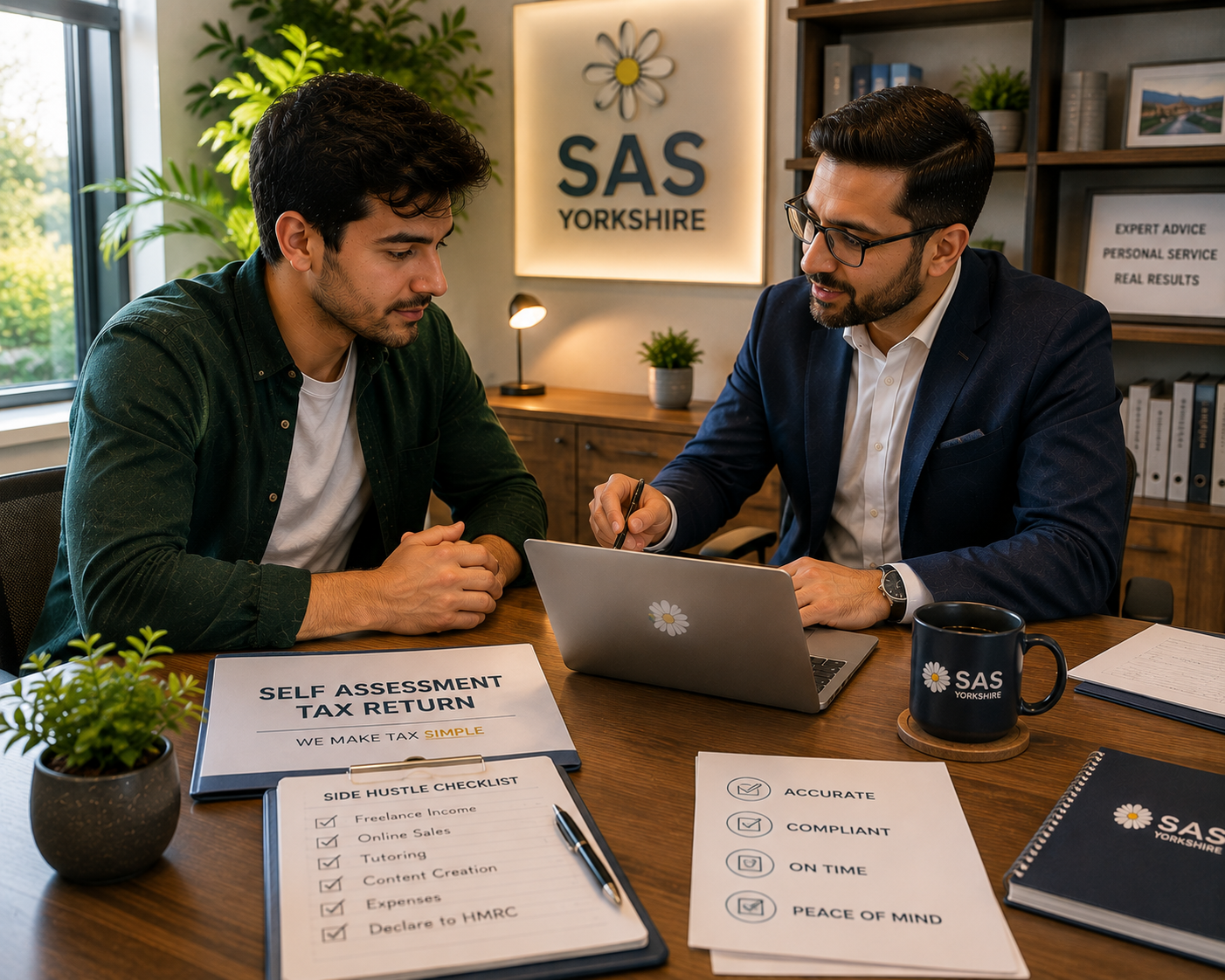
What Does HMRC Consider a Side Hustle?
“Side hustle” is an informal expression rather than a separate legal or tax status. HMRC is interested in the nature of the activity and the income it generates.
You may be trading if you regularly provide services, make products to sell, buy goods with the intention of reselling them for profit or operate an activity in a business-like way. Common examples include freelance design, photography, tutoring, beauty treatments, consultancy, food delivery, gardening, home repairs and social-media content creation.
Income from casual work can still be taxable. An activity does not need to be your full-time occupation, have a business name or use dedicated premises before it can count as trading.
The rules for side income tax in Huddersfield are the same as those applying throughout the UK. The important factors are what the income relates to, your total gross receipts and whether any available allowance applies.
Selling Personal Belongings Is Not Always Trading
One of the most common areas of confusion concerns online selling.
If you clear out your loft and sell unwanted clothes, furniture or household belongings, you are unlikely to be trading simply because the items are listed online. You may also sell them for less than you originally paid, meaning there is no trading profit.
The position can change if you deliberately buy items to sell at a higher price, manufacture products for customers or regularly source stock with the intention of making money. In those circumstances, HMRC is more likely to regard the activity as a trade.
HMRC confirms that selling personal household items is unlikely to create a tax charge, while buying or making goods to sell for profit is more likely to constitute trading. Separate Capital Gains Tax rules can occasionally apply when valuable personal possessions are sold at a gain. Read HMRC’s guidance on selling through digital platforms.
For example, selling an old bicycle for £200 would not normally make you a trader. Buying several used bicycles, restoring them and selling them regularly for profit could be a trading activity.
How the £1,000 HMRC Trading Allowance Works
The HMRC trading allowance provides an exemption of up to £1,000 of gross trading income in each tax year. It can apply to income from self-employment, casual services and hiring out personal equipment.
The crucial word is gross. The £1,000 threshold is based on the money received before expenses, platform charges, materials or other business costs are deducted.
If your total annual gross trading income is £1,000 or less, full relief may apply. In many cases, you will not need to tell HMRC about that income or file a tax return solely because of the side hustle. You must still keep an accurate record of the income.
There are exceptions. You may still need to register or submit a return if you want to claim a trading loss, pay voluntary National Insurance contributions or prove self-employment for certain benefits. The allowance is also restricted for some income received from an employer, partnership or connected company.
HMRC’s official guidance explains both the allowance and the situations in which it cannot be used. Read the HMRC trading allowance guidance.
The Allowance Covers Your Combined Trading Income
The £1,000 trading allowance is not provided separately for every side hustle, customer or digital platform.
Suppose you receive £600 from tutoring and £700 from freelance writing during the same tax year. Your combined gross trading income is £1,300. You cannot apply a separate £1,000 allowance to each activity. Because the combined amount exceeds £1,000, you will normally need to register for Self Assessment and declare the income.
The same principle applies if you sell through several platforms. Dividing sales between eBay, Etsy, Vinted or another marketplace does not create a fresh allowance for each account.
Property income is subject to a separate property allowance, but different rules and restrictions apply. A landlord should not automatically treat rental income as part of the trading allowance.
Gross Income Is Not the Same as Profit
Exceeding £1,000 of gross trading income does not necessarily mean that the entire amount becomes taxable profit.
Once your gross income is above £1,000, you will normally need to report it. You may then choose between deducting qualifying business expenses or claiming partial relief under the trading allowance.
You cannot claim both the £1,000 trading allowance and actual business expenses against the same income.
Consider a Huddersfield graphic designer who receives £3,000 from occasional projects and incurs £800 of allowable expenses. Deducting the actual expenses would leave a profit of £2,200. Claiming the £1,000 trading allowance instead would leave £2,000 to be included in the tax calculation. In this simplified example, using the allowance would produce the lower figure.
If the designer’s allowable expenses were £1,400, claiming those expenses could be more beneficial because the resulting profit would be £1,600.
The best option therefore depends on the actual figures. HMRC permits qualifying self-employed business costs to be deducted when calculating taxable profit, but confirms that expenses cannot also be claimed when the trading allowance is used. See HMRC’s allowable-expenses guidance.
What If You Are Employed as Well?
Having a PAYE job does not prevent you from being self-employed at the same time.
Your employer will usually deduct tax and National Insurance from your salary through payroll. However, tax may not have been deducted from your side-hustle income. If the side activity requires a Self Assessment return, employment and self-employment details are normally included on the same return.
Your salary and taxable side-hustle profit are considered together when calculating your overall Income Tax liability. You do not receive a separate Personal Allowance for each income source.
This means somebody whose salary already uses their Personal Allowance may pay tax on most or all of their taxable side-hustle profit. It is sensible to put money aside as income is earned rather than waiting until the payment deadline.
When Does a Huddersfield Side Hustle Require Self Assessment?
You will generally need to register as a sole trader and complete a Self Assessment tax return if your gross trading income exceeds £1,000 during the tax year.
A return may also be required for other reasons, including untaxed property income, certain investment income, foreign income, taxable capital gains or partnership income. The fact that your side-hustle receipts are below £1,000 does not remove an existing obligation to file a return for another reason.
HMRC provides an online tool for people who are uncertain about casual jobs, online selling, content creation and other additional income. Check whether you need to tell HMRC about additional income.
If you are already registered for Self Assessment, do not simply leave side income out of the return because it falls below £1,000. The applicable allowance and reporting treatment should be considered when preparing the complete return.
Do Online Platforms Report Sellers to HMRC?
Digital platforms can collect seller information and report income details to HMRC under rules introduced from 1 January 2024. Information may include a seller’s identity, address, tax identification number and amounts received through the platform.
Receiving a platform statement—or having your details reported—does not automatically mean that tax is due. The underlying activity must still be considered. Someone selling unwanted personal possessions is in a different position from someone purchasing stock for resale.
Platform reporting thresholds are also separate from the £1,000 trading allowance. A marketplace not reporting a seller does not mean the income can be ignored, while being reported does not necessarily mean the seller owes tax.
Another complication is that platform reports are commonly prepared for the calendar year, whereas UK individual tax returns normally cover the tax year from 6 April to 5 April. Your own records therefore remain essential.
Self Assessment Deadlines for Side Income
For side-hustle income received between 6 April 2025 and 5 April 2026, a person who needs to file for the first time should normally register for Self Assessment by 5 October 2026.
The paper return deadline is 31 October 2026. The online filing deadline and the deadline for paying the tax due are both 31 January 2027.
If your taxable side hustle began on or after 6 April 2026, it falls within the 2026/27 tax year. Registration would normally be required by 5 October 2027, with the online return and payment due by 31 January 2028.
HMRC updates its deadline guidance for each filing year, so dates should always be checked before acting. View the current Self Assessment deadlines.
Missing the online filing deadline can result in an initial £100 penalty. Additional daily and percentage-based penalties can follow if the return remains outstanding, while late tax payments can attract interest and separate penalties. See HMRC’s Self Assessment penalty guidance.
What Records Should Side-Hustle Owners Keep?
Good records make it easier to decide whether the £1,000 threshold has been exceeded and whether claiming the trading allowance or actual expenses would produce the better result.
Keep evidence of all income received, including cash payments. Invoices, customer receipts, bank statements, payment-processor reports, platform statements and booking records can all be relevant. If you plan to claim actual expenses, retain receipts and evidence showing why each cost relates to the business.
Do not rely exclusively on the amount transferred to your bank. A platform may deduct commission before paying you, while the trading-allowance threshold is based on gross trading income before expenses.
Self-employed taxpayers generally need to retain their business records for at least five years after the 31 January submission deadline for the relevant tax year. Check HMRC’s record-retention rules.
Remember Payments on Account
A first Self Assessment bill can be larger than expected because HMRC may also request a payment towards the following year’s liability.
Payments on account are normally required unless the previous year’s relevant tax liability was below £1,000 or more than 80% of the tax was collected outside Self Assessment. They are generally paid in two instalments on 31 January and 31 July, with each instalment usually equal to half of the previous year’s relevant liability.
Someone filing for the first time could therefore need to pay the full tax bill for the completed year and the first payment on account on the same 31 January. Read HMRC’s explanation of payments on account.
Preparing the return early provides more time to understand and budget for the amount due.
Could Making Tax Digital Affect a Successful Side Hustle?
Making Tax Digital for Income Tax began applying to qualifying sole traders and landlords from 6 April 2026.
The first mandatory group generally includes people whose qualifying gross self-employment and property income exceeded £50,000 in 2024/25. The threshold falls to more than £30,000 based on 2025/26 income for entry from April 2027, and more than £20,000 based on 2026/27 income for entry from April 2028.
A small occasional side hustle will therefore not usually enter the scheme immediately. However, a growing freelance or online business may eventually be affected, particularly where property income is also received. Check the current Making Tax Digital thresholds.
Common Side-Hustle Tax Mistakes
A frequent mistake is measuring profit against the £1,000 threshold instead of gross income. If you receive £1,500 and spend £700, your profit may be £800, but your gross income still exceeds the registration threshold.
Other problems include assuming every selling platform has its own allowance, failing to combine income from several activities, claiming expenses as well as the trading allowance, overlooking cash payments and believing that income does not count because the activity is only part-time.
Some taxpayers also confuse the trading allowance with the Personal Allowance. They are different provisions serving different purposes. Exceeding the £1,000 trading-income threshold can create a filing requirement even if your final tax calculation shows that no Income Tax is payable.
How SAS Yorkshire Can Help Huddersfield Side-Hustle Owners
A side hustle should create opportunity, not uncertainty about tax returns and HMRC correspondence.
SAS Yorkshire can help Huddersfield residents determine whether their activity counts as trading, calculate gross income, compare the trading allowance with allowable expenses and prepare an accurate Self Assessment tax return.
We can also review employment income, platform statements, payments on account and other income sources so that the return reflects your complete tax position.
If your side hustle has exceeded £1,000, you have received a notice to file or you are uncertain whether past income should have been declared, early advice can make the position easier to resolve.
Learn more about our Self Assessment tax return service or contact SAS Yorkshire to discuss your circumstances.

Final Thoughts
Not every Huddersfield side hustle requires a tax return. Selling ordinary unwanted belongings is not normally the same as trading, and gross trading income of no more than £1,000 may be covered by the HMRC trading allowance.
However, the allowance applies to combined gross trading income rather than profit, and it is not a separate £1,000 allowance for each activity or marketplace. Once gross receipts exceed the threshold, registration and Self Assessment will usually be required.
Keeping records from the first sale or customer payment is the safest approach. It allows you to identify when the threshold is crossed, claim the most suitable relief and file before the relevant deadline.
This article provides general information and does not constitute personalised tax advice. Tax treatment depends on individual circumstances, and HMRC rules can change.
Frequently Asked Questions
1. Do I need to declare a side hustle earning less than £1,000?
If your combined gross trading income for the tax year is £1,000 or less, the trading allowance may provide full relief and you may not need to notify HMRC solely because of that income. Exceptions apply, including where you want to claim a loss or cannot use the allowance.
2. Is the £1,000 trading allowance based on income or profit?
It is based on gross trading income before expenses and other deductions. Receiving more than £1,000 can therefore create a reporting requirement even if your profit after expenses is below £1,000.
3. Do I receive a £1,000 allowance for each side hustle?
No. The allowance generally applies to your combined qualifying trading income from one or more trades. For example, £600 of tutoring income and £700 of freelance income produces combined gross receipts of £1,300.
4. Do I need to declare money made by selling items online?
Selling unwanted personal belongings is unlikely to be trading. If you buy or make products to sell for profit, operate regularly or provide services through a platform, the income is more likely to be taxable trading income.
5. Can SAS Yorkshire complete my Huddersfield Self Assessment return?
Yes. SAS Yorkshire can review your side-hustle income, employment figures, expenses and other taxable income, determine whether the trading allowance is appropriate and prepare and submit your Self Assessment return.