
Payments on Account Sheffield | Self Assessment Guide
Completing your Self Assessment tax return can bring a sense of relief—until you see the amount HMRC expects you to pay.
For many sole traders, freelancers, landlords and other taxpayers in Sheffield, the first Self Assessment bill is significantly higher than anticipated. This is often because HMRC is requesting payment for the completed tax year and an advance payment towards the following year.
These advance amounts are known as payments on account.
Payments on account are not an additional tax or a penalty. They are instalments towards your next Self Assessment liability. However, if you were expecting to pay only the tax shown for your first year, the extra amount due on 31 January can create a serious cash-flow problem.
Understanding how payments on account work allows you to budget properly, check HMRC’s calculation and determine whether the payments can legitimately be reduced.
What Are Payments on Account?
Payments on account are advance payments towards your next Self Assessment tax bill. They normally cover Income Tax and, where applicable, Class 4 National Insurance contributions.
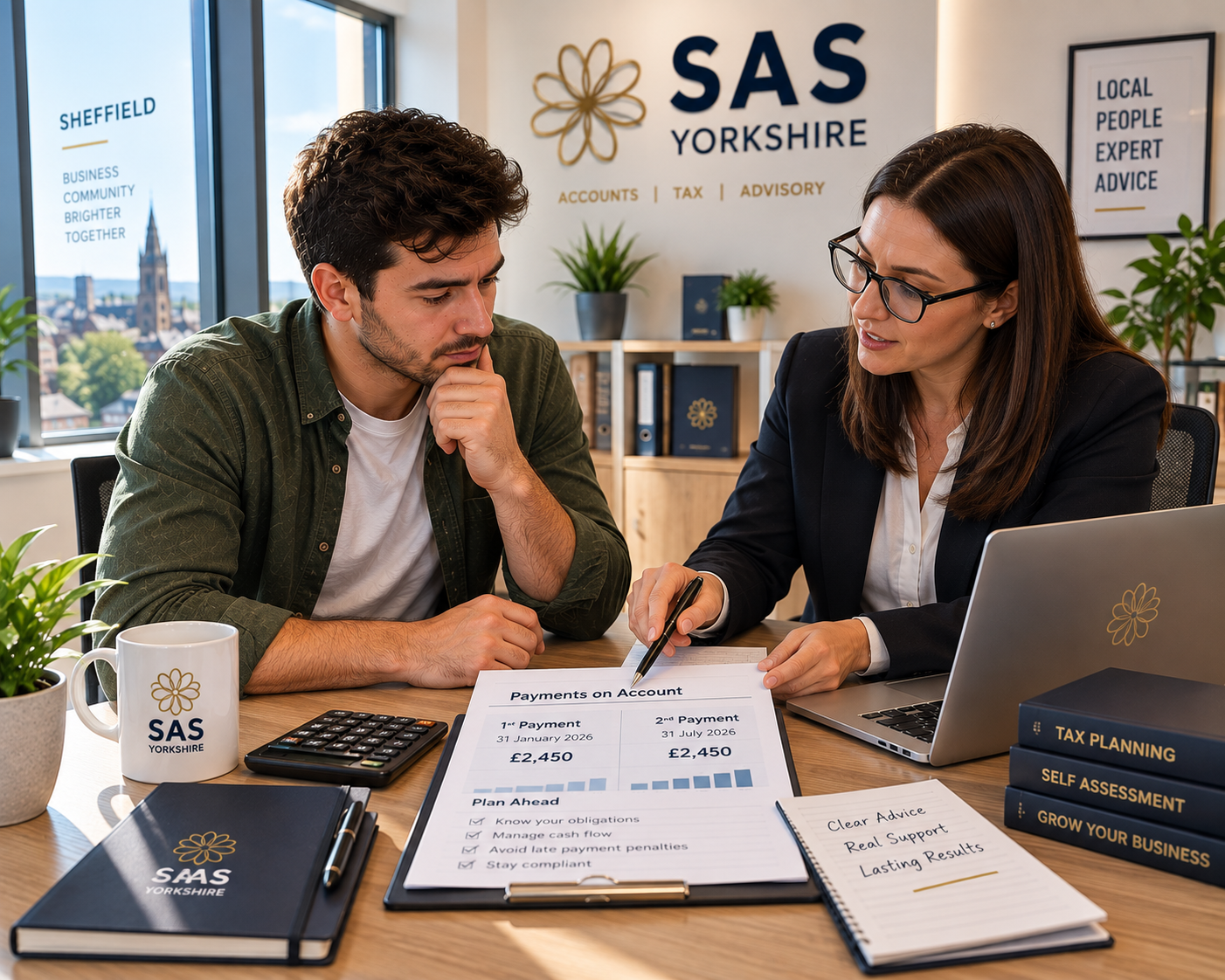
HMRC usually divides the estimated liability into two equal instalments. The first is due on 31 January and the second on 31 July.
Each instalment is generally equal to half of the relevant tax liability from your previous return. HMRC assumes that your income and tax position will be broadly similar in the following year.
For example, if the relevant tax liability shown on your return is £4,000, HMRC may request two payments on account of £2,000 each. The first would be due on 31 January and the second on 31 July.
When your next tax return is completed, the payments already made are deducted from the actual liability. Any remaining amount becomes a balancing payment. If you paid too much, the excess can normally be refunded or credited against another amount due.
HMRC explains the calculation and relevant exceptions in its official payments-on-account guidance.
Who Has to Make Payments on Account?
Payments on account commonly apply to self-employed people, individual partners, landlords and other taxpayers who pay a meaningful proportion of their tax through Self Assessment.
You will not normally have to make them if your relevant Self Assessment tax liability for the previous year was less than £1,000.
The wording matters: the exception applies when the liability is less than £1,000. A relevant liability of exactly £1,000 can still produce payments on account unless another exception applies.
Payments will also not normally be required if more than 80% of your total tax was already collected outside Self Assessment. This might apply where most of your tax was deducted through PAYE and only a relatively small amount remains payable through your return.
A Sheffield resident who has a full-time PAYE job and a small amount of freelance income may therefore be treated differently from a full-time sole trader, even where both submit Self Assessment returns.
Limited companies do not make these personal Self Assessment payments towards Corporation Tax. However, company directors may have payments on account for personal income reported through Self Assessment, such as dividends, rental profits or separate self-employment income.
Why Does the First Self Assessment Tax Bill Feel So High?
The first bill often feels high because two different liabilities can fall due together.
Your tax for the completed year is being paid in arrears. At the same time, HMRC may request the first payment towards the following year.
This means that a new taxpayer can be asked to pay approximately 150% of the first year’s relevant liability on 31 January. A further 50% is then due on 31 July.
Consider a self-employed Sheffield tradesperson whose first 2025/26 Self Assessment calculation produces an eligible Income Tax and Class 4 National Insurance bill of £3,000.
By 31 January 2027, the trader may need to pay the £3,000 liability for 2025/26 plus a first payment on account of £1,500 towards 2026/27. The total due on that date would be £4,500.
A second payment on account of £1,500 would then be due by 31 July 2027.
Across the two payment dates, the trader will have paid £6,000: £3,000 for the completed year and £3,000 towards the following year. The second £3,000 has not disappeared—it will be deducted when HMRC calculates what remains payable for 2026/27.
How the Balancing Payment Works
Payments on account are estimates based on the previous year. Your eventual liability may be higher or lower.
Suppose the Sheffield trader in the previous example makes two payments on account totalling £3,000 towards 2026/27. When the 2026/27 return is completed, the actual relevant liability is calculated as £3,600.
The two advance payments cover £3,000, leaving a balancing payment of £600. This would normally be due on 31 January 2028.
The trader may also need to make the first payment on account towards 2027/28 on the same date. If that payment is calculated as half of the £3,600 liability, another £1,800 would be due. The total payable on 31 January 2028 would therefore be £2,400.
If the actual liability had been only £2,000, the trader would have paid £1,000 too much through the two £1,500 instalments. That excess could normally be repaid or allocated against another liability.
Capital Gains Tax and student-loan amounts included within a Self Assessment calculation do not normally form part of the following year’s payments on account. They may instead be collected as part of the balancing amount.
What Are the Current Self Assessment Deadlines?
For the tax year running from 6 April 2025 to 5 April 2026, somebody who needs to file for the first time should normally notify HMRC by 5 October 2026.
The deadline for a paper tax return is 31 October 2026. The online filing and payment deadline is 31 January 2027.
If payments on account apply, the first payment towards 2026/27 will also be due on 31 January 2027. The second will be due on 31 July 2027.
Submitting the return earlier does not bring the statutory payment date forward. It simply tells you how much will be payable, giving you more time to prepare. Current dates can be checked through the HMRC Self Assessment deadline guidance.
Leaving the return until January may mean discovering a substantial bill only days before it must be paid.
Can Payments on Account Be Reduced?
You can ask HMRC to reduce your payments on account if you reasonably expect the following year’s liability to be lower.
This may be appropriate when profits have fallen, a major customer has been lost, a business has stopped trading or your circumstances have changed. It might also apply where considerably more tax is now being deducted through PAYE.
A reduction can be requested through your HMRC online account or by submitting form SA303. You will need to estimate the lower liability and state the revised payment amount.
However, payments should not be reduced simply because the bill is inconvenient. If the reduction is excessive and the eventual liability is higher than your estimate, HMRC can charge interest on the underpaid amount.
For example, suppose payments on account of £2,000 each are reduced to £1,000 each because profits are expected to fall. If the eventual liability shows that the original payments should have been higher, interest may be calculated on the shortfall from the original payment dates.
A realistic profit forecast is therefore essential before requesting a reduction.
What Happens If Your Profits Increase?
If your profits increase, you are not normally required to increase the existing payments on account immediately.
The advance payments remain based on the previous return. When the next return is filed, the higher actual liability will create a balancing payment.
Although HMRC may not request the extra amount until the following 31 January, the money should still be reserved. Otherwise, the higher balancing payment and the first instalment for the next year could create another cash-flow shock.
Growing Sheffield businesses should update their expected tax calculations during the year rather than relying exclusively on HMRC’s previous estimate.
Do You Still Pay If the Business Has Closed?
Stopping self-employment does not automatically cancel payments already showing on your account.
If your business has closed and you expect little or no taxable profit for the following year, it may be possible to reduce the payments on account, potentially to zero. However, the final figures must be prepared carefully because other Self Assessment income could still create a liability.
You may also need to tell HMRC that you have stopped trading and complete a final tax return. Outstanding tax for earlier periods remains payable even though the business is no longer operating.
Reducing payments without updating the wider Self Assessment position can lead to incorrect statements, interest and further correspondence.
Planning for Payments on Account
The best way to manage a Self Assessment tax bill in Sheffield is to treat tax as an ongoing business cost rather than a once-a-year surprise.
Maintain up-to-date records of income and allowable expenses throughout the year. Review your estimated profit regularly and keep tax money separate from everyday business funds.
Filing early is particularly valuable during the first year. If your return is completed in the summer or autumn, you may have several months to prepare for the January payment.
Cash-flow forecasts should include both the 31 January and 31 July instalments. Many traders remember the January deadline but overlook the second payment because no new tax return is due in July.
It is also important to review whether all legitimate expenses and allowances have been claimed. An accurate return can reduce taxable profit, but personal spending or unsupported estimates should never be included as business expenses simply to lower the bill.
What Happens If a Payment Is Late?
Late payments can attract interest from the day after the deadline. HMRC may also charge penalties of 5% of the unpaid tax at 30 days, six months and twelve months.
These charges are separate from penalties for filing the tax return late. A return can therefore be submitted on time while payment penalties and interest continue to arise because the bill remains unpaid.
Likewise, paying an estimated amount does not remove the obligation to submit the return.
HMRC’s current penalty structure is available in its Self Assessment penalties guidance.
What If You Cannot Pay the Full Amount?
Ignoring the bill is rarely the best response. If you cannot pay in full, contact HMRC as early as possible.
You may be able to arrange a Time to Pay agreement that spreads the liability over instalments. HMRC will consider whether the arrangement is affordable and may ask about your income, expenses, assets and ability to make payments.
Interest will generally continue to apply, but an agreed arrangement can help prevent the situation from escalating. HMRC provides further information about payment plans for taxpayers who cannot pay on time.
You should still file your return by the deadline, even if you cannot pay the resulting bill. Filing on time can prevent separate late-filing penalties from being added to the amount already owed.
Common Mistakes Made by Local Traders
One common mistake is assuming that a payment on account is a duplicate charge. It is an advance payment that will be credited against the following year’s liability.
Another is budgeting only for the tax shown for the completed year. A first-time filer may also face the first 50% payment on account on the same date.
Some taxpayers incorrectly reduce their payments to zero without a reasonable basis. If profits remain similar, the missing tax will eventually become payable and interest may be charged.
Others forget the 31 July instalment because it falls outside the main tax-return season. Missing that date can result in interest and penalties even though the return itself was submitted on time.
Finally, taxpayers sometimes assume HMRC’s estimate must be correct. Payments on account are based on historical information. If your circumstances have genuinely changed, the amount should be reviewed rather than accepted automatically.
How SAS Yorkshire Can Help Sheffield Traders
Payments on account are manageable when the calculation is understood and planned for in advance.
SAS Yorkshire can prepare your Self Assessment return, explain every part of the resulting bill and check whether HMRC’s payments on account are appropriate. We can also compare the estimate with your current trading performance and help request a reduction where there is a reasonable basis.
Our support is suitable for Sheffield sole traders, freelancers, landlords, partnership members and individuals with several sources of income.
Completing the return early can give you a clearer picture of the amount due and more time to arrange your finances. It also reduces the risk of errors, overlooked expenses and last-minute filing problems.
Learn more about our Self Assessment tax return service or contact SAS Yorkshire to discuss your tax position.

Final Thoughts
Payments on account are not a second tax bill. They are advance instalments towards the following year’s Self Assessment liability.
The first January payment can nevertheless feel severe because the completed year’s tax and the first advance instalment become payable together. A second instalment then follows on 31 July.
Sheffield traders should complete their returns early, maintain accurate records and set aside money throughout the year. If profits are expected to fall, the payments may be reduced—but only using a reasonable estimate.
Professional advice can help you understand what HMRC is requesting, avoid an unnecessary overpayment and prepare for every approaching deadline.
This article provides general information rather than personalised tax advice. Individual circumstances differ, and tax rules may change.
Frequently Asked Questions
1. Why is my first Self Assessment bill 50% higher than expected?
You may be paying the full liability for the completed tax year plus the first payment on account towards the next year. The first advance instalment is normally 50% of the relevant previous-year liability.
2. When are payments on account due?
The first payment is normally due on 31 January, with the second due on 31 July. Any balancing payment is generally due on the following 31 January.
3. Do I need to make payments on account if my bill is £1,000?
Potentially, yes. The automatic exemption applies when the relevant liability is less than £1,000. Payments may still not be required if more than 80% of your total tax was collected outside Self Assessment.
4. Can I reduce my payments on account if my Sheffield business earns less?
Yes. You can apply to reduce them if you reasonably expect the following year’s liability to be lower. If you reduce them excessively, HMRC may charge interest on the shortfall.
5. Can SAS Yorkshire check my Self Assessment payments on account?
Yes. SAS Yorkshire can review your tax calculation, explain the January and July amounts, assess whether a reduction is appropriate and prepare your Self Assessment return.