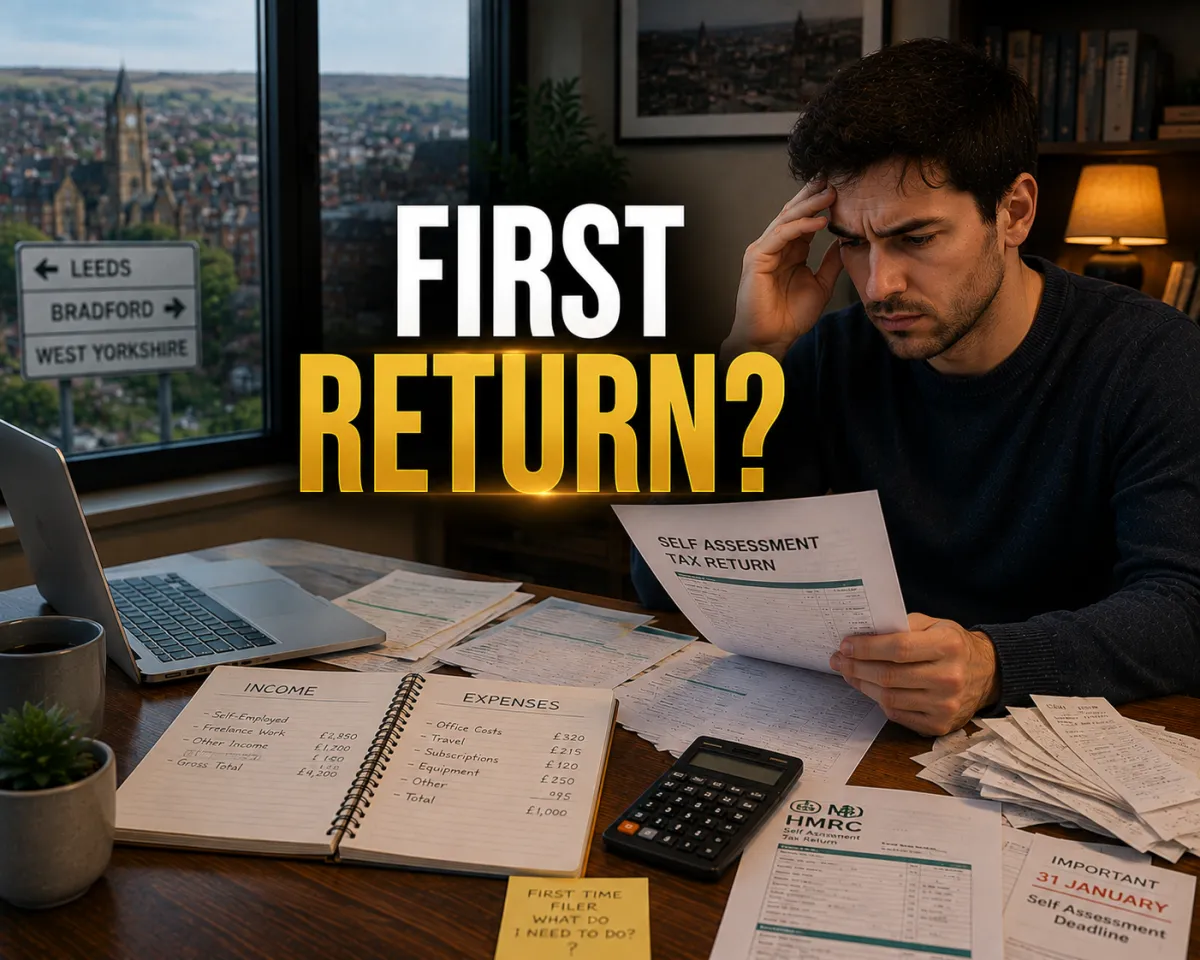
Self Assessment West Yorkshire: First-Time Filing Guide
Your first tax return usually comes with more questions than answers. Do you need to register with HMRC? Which income should you report? Can you claim expenses? And why might your first payment be higher than the tax you owe for the year?
If you need help with Self Assessment in West Yorkshire, the starting point is understanding that registration, filing and payment are three separate responsibilities. Completing one does not automatically complete the others.
This first-time tax return guide explains the process, the deadlines for the 2025/26 tax year and the common mistakes to avoid. Whether you are a freelancer in Leeds, a landlord in Bradford or a new sole trader in Batley, the same HMRC rules apply.
What Is Self Assessment?
Self Assessment is HMRC’s system for collecting tax that has not been fully deducted automatically from your income.
Employees often pay Income Tax through PAYE before receiving their wages. However, income from self-employment, property and certain other sources may need to be reported separately through a tax return.
Your return brings together the relevant income, expenses, reliefs and tax already paid for a particular tax year. It allows your overall liability to be calculated and shows whether you owe more or may be entitled to a repayment.
There is no separate West Yorkshire tax return. People in Leeds, Bradford, Wakefield, Huddersfield, Halifax and Batley use the national Self Assessment system.

Who Needs to File a First Tax Return?
You will normally need to submit a return if you operated as a sole trader and your gross self-employment income exceeded £1,000 during the tax year. Gross income means the amount earned before deducting business expenses.
Partners in business partnerships generally need to file too. A return may also be necessary if you receive rental income, taxable foreign income, untaxed investment income or have certain capital gains or tax charges to report. The exact requirement depends on your circumstances. Check HMRC’s guidance on who must send a tax return.
A common misunderstanding is that no tax bill means no filing requirement. A sole trader can need to file even when their profit is low enough that no Income Tax is payable.
If HMRC has asked you to submit a return, do not ignore the request because you believe you owe nothing. Contact HMRC to establish whether the return is still required.
Which Tax Year Does Your First Return Cover?
The UK tax year runs from 6 April to 5 April—not from January to December.
The 2025/26 tax year covered income from 6 April 2025 to 5 April 2026. Its normal online filing deadline is 31 January 2027.
If you only began trading in August 2026, that activity falls within 2026/27. Assuming you had no earlier reason to file, your first online return would normally be due by 31 January 2028, with registration required by 5 October 2027.
This distinction matters: the next approaching January deadline is not automatically your first deadline. Establish which tax year your income belongs to before starting the return.
Register With HMRC Before Trying to File
First-time filers must register for Self Assessment before using HMRC’s online filing service.
The registration route depends on why you need a return. A sole trader registers as self-employed, while someone registering solely because of rental income or another non-trading reason follows a different route. HMRC’s registration checker directs you to the appropriate process.
Creating an online sign-in does not, by itself, mean you have registered for Self Assessment. Equally, registering does not mean your tax return has been submitted.
Once registered, you receive a Unique Taxpayer Reference, usually called a UTR. This is a ten-digit reference used to identify your tax record. Allow time for registration and access arrangements instead of leaving them until the filing deadline. HMRC explains how to obtain or locate it in its UTR guidance.
If you have registered before, check whether your existing account needs reactivating rather than applying as a completely new taxpayer.
Key Deadlines for the 2025/26 Tax Year
For a first return covering 6 April 2025 to 5 April 2026, the normal deadlines are:
5 October 2026: Tell HMRC you need to file by registering for Self Assessment.
31 October 2026: Ensure HMRC receives a paper return.
31 January 2027: Submit an online return and pay the tax due.
If payments on account apply, the first instalment towards 2026/27 is also normally due on 31 January 2027, followed by the second on 31 July 2027. HMRC sets out the dates in its Self Assessment deadline guidance.
Registering late does not automatically move your payment deadline, even if HMRC gives you a later filing date. If you have already missed a registration deadline, take advice promptly rather than waiting until January.
Gather Your Documents Before Completing the Return
Start with your UTR, National Insurance number and a list of your income sources.
For employment, gather documents such as your P60, P45 and relevant benefits information. For self-employment, collect sales records, invoices, receipts and bank statements. Landlords should organise rental statements and records of property expenditure.
Depending on your circumstances, you may also need savings-interest statements, dividend vouchers, pension information, CIS deduction statements, student loan details and records of asset disposals.
Keep records of tax already deducted as well as income received. Reporting the income without entering the corresponding tax paid can produce an incorrect calculation.
If documents are missing, identify the gaps early. Your accountant can explain which replacement statements or other evidence may be needed.
Understand Turnover, Profit and Allowable Expenses
Turnover is your business income before expenses. Profit is what remains after the relevant business costs and tax adjustments.
For example, £25,000 of sales does not necessarily mean £25,000 of taxable profit. If you have qualifying expenses, these can reduce the amount on which tax is calculated.
Potential expenses include business insurance, software, advertising, stock, professional fees and qualifying travel. Where something is used personally and for business, only the business element is normally allowable.
You cannot deduct actual business expenses while also using the £1,000 trading allowance against the same trading income. Equipment and vehicle purchases may need separate consideration. HMRC’s self-employed expenses guidance explains the main rules.
Landlords should use the property-income rules rather than assuming every sole-trader expense rule applies to rental activity.
Will You Automatically Owe Tax?
Filing a return does not automatically mean you will have a bill.
The standard Personal Allowance for 2025/26 was £12,570, although entitlement and the amount available depend on your circumstances. Importantly, you do not receive a separate Personal Allowance for each job or business. Employment income may already have used some or all of it. See HMRC’s Income Tax allowances.
Your calculation may also include self-employed National Insurance, student loan repayments or other charges.
This is why comparing your business income alone with a single threshold can be misleading. The complete financial picture matters.
How to Complete and Submit Your First Return
Many individuals can file through HMRC’s online service. You answer questions about your circumstances so that the appropriate sections are included, then enter the relevant income, expenses and reliefs.
Check your employment details, business figures and tax already paid carefully. Do not assume that information entered automatically by the system is complete or correct.
Some circumstances require commercial software or a different filing route, including certain non-resident returns. Check the exclusions before relying on the free HMRC online filing service.
Before submission, review the calculation and investigate anything unexpected. Saving a draft is not the same as submitting it: complete the declaration and submission process, then retain the confirmation and a copy of the finished return.
Why Your First January Bill Can Be Larger Than Expected
Payments on account are advance instalments towards the following year’s Income Tax and, where applicable, Class 4 National Insurance.
They are normally required unless the relevant previous-year bill was less than £1,000 or more than 80% of the tax was collected outside Self Assessment. Each instalment is generally half the previous year’s relevant liability.
For an illustrative first return, suppose your 2025/26 Income Tax and Class 4 liability is £2,000, with nothing already paid or deducted and no other charges. If payments on account apply, you could need £3,000 on 31 January 2027: £2,000 for 2025/26 plus £1,000 towards 2026/27. Another £1,000 would normally follow on 31 July 2027.
That extra January amount is an advance payment, not a first-time filing fee. Read HMRC’s explanation of payments on account.
Filing Your Return Does Not Pay Your Bill
Submitting the return tells HMRC your figures. You must separately arrange payment unless an appropriate collection arrangement is already in place.
Use the correct payment reference and allow enough processing time for your chosen method. Filing early does not normally bring forward the payment deadline, but it gives you more time to budget. HMRC lists the available Self Assessment payment methods.
If you cannot afford the bill, still submit the return on time. Contact HMRC promptly to discuss whether an affordable Time to Pay arrangement is available. Approval is not automatic. See HMRC’s guidance on difficulty paying a tax bill.
What Happens If You Miss the Deadline?
Under the standard Self Assessment late-filing rules, missing the filing deadline can trigger an initial £100 penalty, even if no tax is due. Further charges can follow when the return remains outstanding.
Late payment is a separate issue and can attract interest and penalties. Late registration can also lead to a failure-to-notify penalty, depending on the unpaid tax and circumstances. HMRC explains the different charges in its Self Assessment penalties guidance.
There is no general penalty exemption simply because it is your first return. Starting early is particularly important when you still need to register, obtain documents or resolve access problems.
Does Making Tax Digital Affect First-Time Filers?
Making Tax Digital for Income Tax introduces digital records, compatible software and quarterly updates for qualifying sole traders and landlords. It does not mean every first-time filer immediately needs quarterly reporting.
The April 2026 entry threshold was qualifying income above £50,000 in 2024/25. Qualifying income above £30,000 in 2025/26 generally brings a taxpayer into the system from April 2027, subject to exemptions. The threshold falls to more than £20,000 in 2026/27 for entry from April 2028.
Qualifying income generally combines gross self-employment and property income before expenses. Your first return can therefore help determine a future start date. Check HMRC’s Making Tax Digital eligibility guidance.
The 2025/26 annual return is still required even where you are already using Making Tax Digital for a later tax year.
Keep Your Records After Filing
Do not dispose of invoices and receipts once the return has been submitted.
Self-employed business records must generally be retained for at least five years after the relevant 31 January filing deadline. For an on-time 2025/26 return, that means keeping them until at least the end of January 2032. Different rules can apply to non-business records or late returns. See HMRC’s record-retention guidance.
Store your submitted return, calculation, payment confirmations and supporting records together so they are available if questions arise.
Getting Local Self Assessment Support in West Yorkshire
You do not have to use an accountant, but support can be valuable when you are unfamiliar with the process, have several income sources or are unsure about expenses.
SAS Yorkshire offers Self Assessment tax return services for individuals, sole traders and landlords. We can help review your records, prepare the figures, explain the calculation and submit the return after your approval.
An accountant should use the appropriate HMRC authorisation process. You should not hand over your personal HMRC sign-in credentials. HMRC explains this in its agent authorisation guidance.
For practical help with Self Assessment in West Yorkshire, contact SAS Yorkshire. Getting started before the deadline gives you time to resolve questions and understand the bill before it needs paying.
This guide provides general information, not personalised tax advice. Requirements depend on your circumstances. Information checked on 31 August 2026.

Frequently Asked Questions
1. Do I need to file if my business profit is below the Personal Allowance?
You may still need to file. The normal sole-trader filing threshold relates to gross self-employment income exceeding £1,000, not whether your profit exceeds the Personal Allowance. Other income and any HMRC notice to file also matter.
2. When is my first online tax return due?
For income belonging to 2025/26, the normal online deadline is 31 January 2027. If your first relevant income arose in 2026/27, the deadline would normally be 31 January 2028. Confirm the correct tax year before filing.
3. Do I need a UTR before filing?
Yes, you normally need your personal Unique Taxpayer Reference to file online. HMRC issues it when you register for Self Assessment. It is different from your National Insurance number and online sign-in details.
4. Can I complete my first tax return without an accountant?
Yes. Many people complete straightforward returns themselves using HMRC’s online service. Professional help may be worthwhile if you have missing records, rental income, several income sources or uncertainty about allowable expenses.
5. What if I cannot pay my first tax bill?
Submit the return on time and contact HMRC as soon as possible. You may be able to agree a Time to Pay arrangement, depending on affordability and eligibility. Delaying the return can create additional filing penalties.